

When Human Work Becomes a Luxury
With the rapid rise of AI, we seem to be moving towards a future in which machines will automate much of what we do and machine-produced goods will become increasingly common. This creates an interesting paradox: as production becomes faster, cheaper, and more accessible, human involvement may become more valuable.
In a recent interview with The Economist, Elon Musk predicted that money may eventually lose its relevance. He described a future of extraordinary abundance in which AI and robotics could produce more goods and services than people could possibly consume.
Whether or not this prediction becomes reality, it raises an important question: if machine-produced goods become cheaper and more widely available, will human-made objects acquire a different kind of value? In this scenario, human labour could become a new form of luxury, not because it is necessarily more efficient or technically superior, but because it carries the decisions, imperfections, wisdom, and personal history of the person who created it.
At the same time, certain forms of intelligence may soon become cheap and accessible to almost everyone, as we move closer to what some describe as an era of “superintelligence”. This does not mean that human creativity will become irrelevant. On the contrary, it creates an opportunity to reconsider what creativity is and where its value lies. When almost anyone can use the same tools to produce an image, a text, or an idea, the difference may no longer lie in the ability to produce something. It may lie in who makes the decisions, why they make them, and how the idea is translated into the world.
I see a lot of resistance to this technology within the art world, and it’s a familiar reaction. It reminds me of what happened when social media first became part of our daily lives.
Many of the communities and art institutions that initially demonised these platforms slowly began to adopt them. Once they saw their audiences and engagement growing, they understood that social media had to be taken seriously. It was no longer simply a question of whether using it was right or wrong. By that point, a significant part of their programming, marketing, communication, and branding was already operating through those platforms.
The same may happen with AI. Artists cannot respond to this transformation simply by boycotting or demonising the technology. They need to challenge it, push against it, and understand what it can and cannot do. The real challenge is not to prove that humans are better than machines. It is to define what human authorship can mean when the creative process is increasingly shared with them.
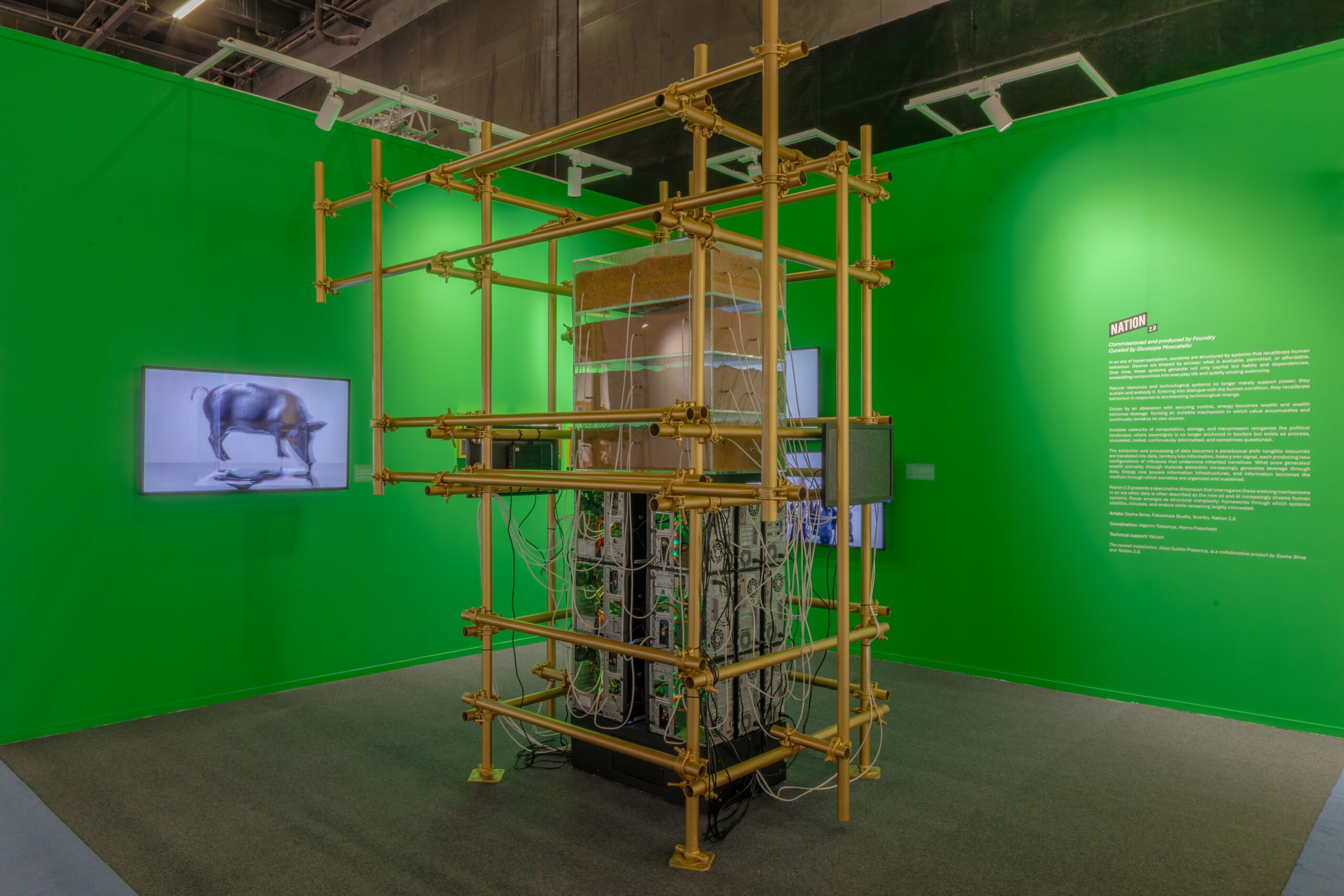
This question was central to Nation 2.0, an exhibition I curated for Art Dubai. In collaboration with Sasha Sime, we presented a large multimedia installation developed from a series of AI-generated images. Rather than leaving those images in the digital space, we decided to reproduce the installation physically, piece by piece, using natural materials, computers, cables, scaffolding, and many other components.
AI generated the initial vision, but it could not simply transfer that vision into the physical world. The installation had to be interpreted, engineered, adapted, and constructed. Every material imposed limitations. Every decision affected another part of the structure. The process required judgement, collaboration, technical knowledge, intuition, and physical labour.
What interested me was not only proving that humans could reproduce what AI had imagined. It was also discovering what happened during the process of translation. A machine may imitate the result, but the human experience behind its creation remains far more difficult to replicate.
Leave a Reply